
Why Upbit Account Safety Deserves More Than a Password
December 10, 2024Why multi-chain wallets + pre-sign safety will shape DeFi’s next phase
January 19, 2025Wow! I remember the first time I held a smart-card wallet in my hand—felt like carrying a tiny bank vault in my pocket. The card was slim, unassuming, and cold to the touch, but inside it was this surprisingly robust piece of engineering that made me rethink how I store private keys. My instinct said: this could be the bridge between convenience and true offline security. Initially I thought hardware wallets meant bulky devices, but then I realized the form factor didn’t matter as much as tamper-resistance and firmware trust.
Okay, so check this out—smart-card wallets work like a physical, single-purpose computer built to keep secrets. They isolate private keys from general-purpose devices, and they perform signing inside a sealed environment so the keys never leave the card. That protects you against common attack vectors like malware sniffing clipboard data, phishing sites capturing seed phrases, and weak phone backups. On one hand, the idea is simple; though actually, the implementation hides a lot of subtle engineering choices that change how safe you really are.
Seriously? Yes—because not all smart-card implementations are created equal. Some rely on proprietary firmware with opaque update mechanisms, while others lean on standards like EMV or secure elements with audited cryptography. I’m biased, but when a vendor publishes a clear threat model and offers verifiable signatures for firmware, that matters. My mind raced through scenarios: lost card, stolen card, compromised backup. Each case demands different defenses, and the right smart-card wallet design can reduce your exposure dramatically.
Why I stopped trusting seeds on paper alone
Here’s what bugs me about the old paper-seed approach—it’s brittle. Paper tears, burns, gets tossed in a drawer with receipts, or worse, photographed and stored in the cloud without your conscious consent. I met someone at a conference who thought his photos were private—turns out his phone auto-backed up to a service with lax access controls. Oops. My gut said that relying only on a human to preserve a long list of words is a gamble.
And yes, hardware wallets that use mnemonic seeds still place a lot of trust in that initial setup. But smart-card wallets can remove that single point of failure by generating keys inside the secure element right away, meaning there may never be an exposed mnemonic to copy or store. Initially I thought that meant no backups, but then I realized you still need a recovery strategy. Actually, wait—let me rephrase that: you need a recovery strategy that balances security with practicality, like multiple encrypted backups split across trusted locations.
On one hand, you want absolute resilience. On the other hand, you don’t want to create more attack surfaces while trying to be paranoid. That contradiction is where good product design earns its keep.
How a smart card protects private keys—without the drama
Short answer: isolation and minimal attack surface. Long answer: secure elements inside these cards use layers—tamper-evident packaging, hardware cryptography engines, and constrained APIs that only allow very specific operations like signing or deriving addresses, and nothing else. Those constraints mean that even if your phone is completely owned by an attacker, the private key inside the card remains unreachable.
My experience has shown me that the quality of the card’s secure element matters more than flashy UI. Some chips are certified under standards like Common Criteria or FIPS, and that certification brings more than paperwork—it implies rigorous testing and threat modeling. Though certifications aren’t perfect, they are a useful signal when you’re choosing a device.
Remember, too, that the user experience shapes security behaviors. If securing crypto is too annoying, users will take risky shortcuts—like writing seeds on sticky notes labeled “crypto” and taping them to a monitor. Don’t be that person.
The recovery trade-offs you actually need to think about
Hmm… recovery is the part people gloss over during wallet demos. It’s sexy to show contactless signing at a cafe, but not so sexy to talk about losing a card. I lost a cold-storage card once—true story—and I had to walk through my recovery plan in real time. Something felt off about relying on a single encrypted file on a laptop. So I split my backups across two geographically separated safety deposit boxes and an encrypted cloud container that uses multi-factor decryption. That’s overkill for some, and for others it’s a sanity-saver.
So how do smart-card wallets help? Some models offer optional mnemonic export under strict conditions; others use Shamir’s Secret Sharing or multi-device key derivation to avoid a single point of failure. On one hand that complexity adds resilience; on the other hand it can introduce usability hurdles and potential misconfiguration. It’s a balancing act—one that depends on your personal threat model and how paranoid you want to be.
Also, think about lifecycle management. What happens if firmware updates are required? Who signs those updates? Are there transparent reproducible builds? If you can’t answer that, assume there’s risk.
Practical steps to make a smart-card wallet actually secure
First, buy from reputable vendors with a clear security story and verifiable firmware. Second, use a secure provisioning environment when possible—air-gapped is best for seed creation. Third, consider splitting recovery information across locations or using threshold schemes. Fourth, practice your recovery process once, at least once, to ensure you can actually restore funds under stress.
One tip that saved me: label backups by partial hints, not full descriptions. For example, “red binder—third” instead of “crypto seed.” That small obfuscation doesn’t stop a determined burglar, but it helps against accidental discovery. I’m not saying security through obscurity is sufficient, though—I am saying layer it with good cryptography and physical security.
Also, rotate your threat model yearly. Life changes—new devices, new habits, new adversaries. Your backup strategy that worked in 2019 may be fragile today.
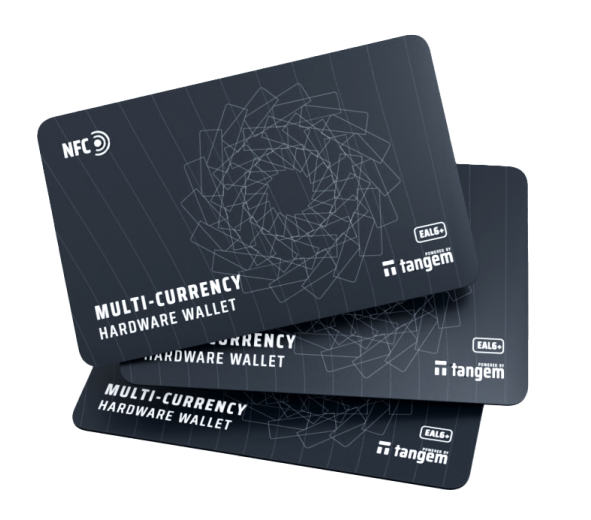
Check this out—if you want a compact option that blends physical convenience with secure elements and real-world usability, look at the tangem hardware wallet to see how these trade-offs play out in a consumer product. It’s a neat example of how cards can be integrated into daily life without turning security into a full-time job.
Common mistakes people make
Many assume “hardware = safe” and stop thinking. That’s dangerous. Others skip firmware updates because they’re inconvenient, which can be worse than skipping updates on a phone because different threats apply. Some people fail to diversify recovery locations, and some keep their recovery phrase on the same device that manages transactions. All of those are avoidable mistakes.
Another big one: social engineering. People will be very creative at coaxing you into a mistake—phone calls, fake support pages, or cloned social profiles pretending to be the vendor. Trust signals matter, but so does a rigid, rehearsed response to any unsolicited request for your recovery details.
FAQ
Can a smart-card wallet be cloned?
Short answer: very unlikely when using a strong secure element. Long answer: cloning requires either extracting the key material (which secure elements are designed to resist) or breaking the cryptographic primitives—both are non-trivial and expensive. Still, nothing is impossible; that’s why you should layer protections and keep backups.
What if I lose my card?
Depends on how you set up recovery. If you used a mnemonic or threshold scheme, follow your recovery steps immediately. If you relied solely on the card without any recovery, funds may be unrecoverable—so don’t do that unless you like living dangerously. Practice recovery before you need it.
Are contactless signatures secure on public terminals?
Contactless operation can be secure if the implementation requires explicit user confirmation for each transaction and the card shows transaction details (or the accompanying app does in a verifiable way). Still, avoid using public or compromised devices when possible; always assume network-level adversaries could try to manipulate transaction metadata.
I’ll be honest—this space still feels a bit like the Wild West. There are great tools, and there are shiny traps. My advice: care about what you buy, practice how you use it, and accept that perfect security is a mirage. Be realistic, be layered, and be prepared. Something else—if this topic bugs you as much as it bugs me, start small: secure one stash, get comfortable, then expand. It’s how habits stick.
Okay, final thought—don’t make security theater your only move. Showing off a fancy card at a meetup is cool, but the real win is when your setup survives a real-life test: a lost device, a phishing attempt, or a computing disaster. Those moments reveal whether your choices were practical or just clever on paper. And yeah, somethin’ about that truth feels oddly satisfying.